

GetBright.se API.GetBright.se Bright Energy Base URL Introduction to As more GetBright.se API.GetBright.se Bright Energy Base URL energy providers embrace digital transformation, APIs have become an essential part of delivering fast, reliable, and automated services. One topic that often appears among developers is getbright.se api.getbright.se bright energy base url. Whether you’re integrating energy services into a mobile application, building internal business software, or simply exploring available developer resources, understanding how an API works is the first step toward successful implementation. GetBright.se API.GetBright.se Bright Energy Base URL
The Bright Energy platform focuses on providing digital energy solutions that simplify how customers and businesses interact with energy-related data. APIs enable applications to communicate with Bright Energy’s backend systems without requiring direct access to internal infrastructure. This creates a secure and scalable way to exchange information between systems.
When developers search for the Bright Energy API base URL, they are usually looking for the main endpoint that applications use to send requests. The base URL serves as the starting point for every API request, making it one of the most important pieces of information in any integration project. GetBright.se API.GetBright.se Bright Energy Base URL
Understanding What an API Base URL Means
Every modern REST API begins with a base URL. Think of it as the foundation upon which every endpoint is built. Instead of typing an entirely different web address for every request, developers simply append specific endpoints to the base URL.
For example, an API may contain endpoints for authentication, customer profiles, billing information, electricity usage, or pricing. Each of these functions extends from the same base URL, making the API easier to maintain and document.
Using a standardized base URL also improves consistency across applications. Developers can build software that communicates with multiple endpoints while relying on a single root address. This reduces coding errors and makes future maintenance significantly easier.
Why Developers Search for API.GetBright.se
The domain api.getbright.se naturally suggests that it functions as the API gateway for Bright Energy services. Developers often search for it while trying to: GetBright.se API.GetBright.se Bright Energy Base URL
- Connect applications to Bright Energy services
- Access developer documentation
- Authenticate API requests
- Retrieve customer or energy usage data
- Build dashboards and automation tools
These searches are common during software development because the API gateway is usually where every request begins. However, simply knowing the domain is not enough. Developers also need authentication methods, endpoint documentation, request formats, rate limits, and response examples. GetBright.se API.GetBright.se Bright Energy Base URL
Without proper documentation, guessing endpoints is neither practical nor recommended. APIs are designed to be accessed according to their official specifications, ensuring security and compatibility.
Common Components of the Bright Energy API
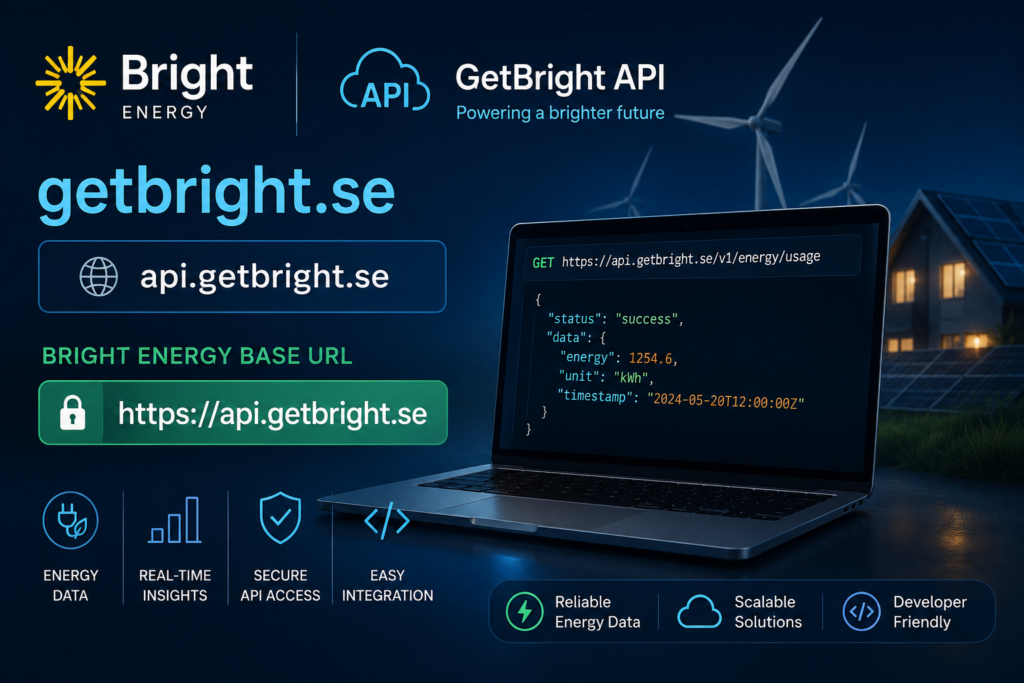
Although every API GetBright.se API.GetBright.se Bright Energy Base URL implementation differs, most modern energy APIs include several core components that developers should understand before beginning integration.
The first component is authentication. Many APIs use API keys, OAuth tokens, or bearer tokens to verify that requests come from authorized applications. Authentication protects customer information and prevents unauthorized access.
Another important component is the endpoint structure. Rather than exposing everything through a single request, APIs organize resources into logical categories. For example, customer information, invoices, subscriptions, and consumption data may each have separate endpoints. GetBright.se API.GetBright.se Bright Energy Base URL
Finally, response formatting plays a major role in development. Most modern APIs return JSON responses because they are lightweight, easy to parse, and supported by nearly every programming language.
Benefits of Using an Energy API
Energy APIs provide far more than simple data access. They enable businesses to automate workflows that would otherwise require manual effort.
For example, customer portals can automatically display electricity usage without employees generating reports manually. Mobile applications can present real-time consumption statistics, helping customers monitor their energy habits more effectively.
Businesses also benefit from improved operational efficiency. Instead of transferring information between systems manually, software applications exchange data automatically through secure API calls. This reduces errors while improving response times.
From a developer’s perspective, APIs encourage modular software architecture. Applications become easier to maintain because they communicate through standardized interfaces rather than tightly coupled systems. GetBright.se API.GetBright.se Bright Energy Base URL
Typical API Workflow
Understanding the workflow of an API makes integration much easier.
The process usually begins with authentication. An application sends credentials to obtain an access token or uses an existing API key supplied by the service provider. Once authentication succeeds, future requests include this authorization information.
Next, the application sends requests to various endpoints under the base URL. These requests may retrieve customer data, update account information, or fetch electricity usage statistics depending on the permissions granted.
Finally, the server processes the request and returns structured data. The application then displays that information to users or stores it for additional processing. Error responses are also returned whenever invalid requests or authorization failures occur, allowing developers to troubleshoot issues efficiently. GetBright.se API.GetBright.se Bright Energy Base URL
Best Practices When Working with the Bright Energy API
Whenever developers integrate with any production API, following best practices is essential. GetBright.se API.GetBright.se Bright Energy Base URL
Always use official documentation rather than relying on assumptions. API endpoints, authentication methods, and required parameters may change over time. Official documentation provides the latest information and minimizes compatibility problems.
Secure API credentials carefully. API keys and authentication tokens should never be hardcoded into public repositories or exposed within client-side code. Instead, they should be stored securely using environment variables or secret management services.
Developers should also implement proper error handling. Network failures, invalid requests, and expired authentication tokens are all normal scenarios. Applications should respond gracefully instead of crashing or displaying confusing messages. GetBright.se API.GetBright.se Bright Energy Base URL
Security Considerations
Security is one of the most important aspects of any API integration.
Encrypted HTTPS communication helps protect sensitive information while it travels across the internet. Developers should avoid sending credentials over unsecured connections and always verify SSL certificates when communicating with production servers.
Authentication tokens should be refreshed according to the provider’s recommendations. Using expired or improperly stored tokens can interrupt service and create unnecessary support issues. GetBright.se API.GetBright.se Bright Energy Base URL
Rate limiting is another security feature commonly found in APIs. Service providers often restrict the number of requests that applications can make within a specific period. Respecting these limits helps maintain system stability while ensuring fair usage for all customers.
Troubleshooting Common API Issues
API integrations occasionally encounter problems, especially during initial development.
One of the most common issues is receiving an authentication error. This often indicates an invalid API key, expired access token, or missing authorization header. Verifying credentials usually resolves the problem quickly.
Developers may also encounter “Not Found” errors. These typically occur when requesting an incorrect endpoint or using an outdated version of the API. Consulting the latest documentation helps eliminate endpoint-related issues.
Server errors can also occur occasionally. In these situations, logging detailed request information while avoiding sensitive credentials helps identify the root cause without compromising security.
Future of Digital Energy APIs
Digital energy platforms continue evolving rapidly as smart grids, connected devices, and renewable energy systems become increasingly common.
Future APIs are expected to provide more real-time data, allowing applications to monitor electricity consumption with greater accuracy. Improved analytics and machine learning integrations may also enable predictive energy insights that help businesses reduce operational costs.
Cloud-native API architectures are making these services more scalable than ever. As organizations adopt microservices and serverless technologies, APIs become even more important for connecting independent software systems efficiently.
For developers, this means continued opportunities to build innovative applications around energy management, sustainability reporting, customer engagement, and automated billing systems.
Conclusion
The keyword getbright.se api.getbright.se bright energy base url primarily relates to developers seeking information about the Bright Energy API and its integration process. The base URL serves as the central entry point for API communication, allowing applications to access various services through organized endpoints.
Successful API integration involves more than knowing the base URL. Developers should understand authentication, endpoint organization, security practices, error handling, and proper documentation before deploying production applications. Following these best practices leads to secure, maintainable, and scalable software.
As the energy industry becomes increasingly digital, APIs will continue to play a vital role in connecting businesses, customers, and smart energy systems. Whether you’re building a customer dashboard, automating internal workflows, or creating a mobile application, a well-designed API provides the flexibility needed to deliver reliable digital experiences.
You May Read Also: GMOD ULX How to Add URL to MOTD

