

Track Perplexity Source URLs Artificial intelligence has changed the way people search for information. Instead of scrolling through dozens of web pages, users can now ask an AI assistant a question and receive a summarized answer within seconds. One feature that makes this experience more reliable is the inclusion of source URLs. If you’ve been searching for ways to track Perplexity source URLs, you’re probably interested in understanding where the AI gets its information and how you can verify or analyze those sources.
Whether you’re an SEO professional, researcher, content creator, marketer, or curious user, tracking AI-generated source URLs provides valuable insights. It allows you to evaluate credibility, discover authoritative websites, analyze citation patterns, and even identify opportunities to improve your own website’s visibility. Track Perplexity Source URLs
In this guide, we’ll explore everything you need to know about tracking Perplexity source URLs, why they matter, and the best practices for analyzing them effectively. Track Perplexity Source URLs
What Does “Track Perplexity Source URLs” Mean?
Perplexity AI typically provides citations alongside many of its responses. These citations point users toward the websites that influenced or supported the generated answer. Tracking these URLs simply means monitoring, collecting, and analyzing those referenced links.
Unlike traditional search engines that present a list of blue links, Perplexity combines multiple sources into a single response. Each citation serves as a transparency mechanism, allowing users to inspect where specific information originated. Track Perplexity Source URLs
For digital marketers and SEO professionals, these source URLs reveal which websites consistently appear as trusted references. This information can be extremely valuable for understanding content authority within a particular niche.
Tracking source URLs isn’t just about curiosity. It helps determine whether an AI answer is based on reputable publications, government websites, academic research, industry blogs, or community discussions. That knowledge improves confidence in the information being presented. Track Perplexity Source URLs
Why Source URLs Matter in AI Search
AI-generated responses are only as reliable as the information used to create them. Source URLs act as a bridge between summarized content and the original material.
When users see references attached to an answer, they gain the opportunity to verify facts independently. This increases transparency and reduces blind trust in AI-generated summaries. Track Perplexity Source URLs
For researchers, citations make it easier to locate original studies, reports, and documentation without repeating multiple manual searches. Instead of spending time looking for evidence, users can jump directly to the cited material.
Businesses also benefit because appearing as a cited source can increase visibility and establish authority. As AI search continues to grow, being referenced frequently may become just as valuable as ranking well in traditional search engines.
Benefits of Tracking Perplexity Source URLs
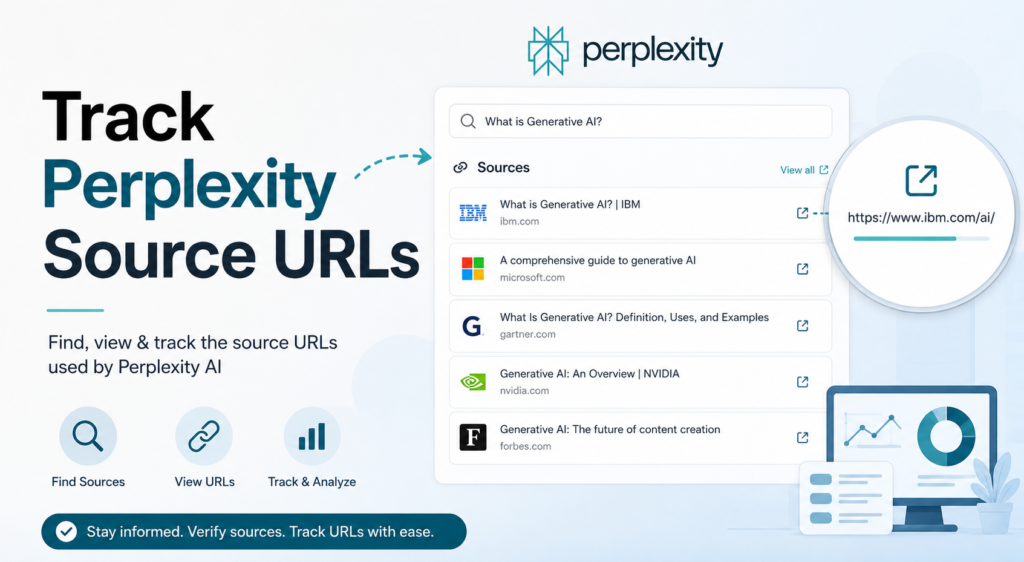
Monitoring track Perplexity source URLs cited URLs offers advantages that extend far beyond simple verification.
One major benefit is competitive research. By observing which domains appear repeatedly for specific topics, marketers can identify industry leaders and understand what kind of content AI systems consider authoritative.
Another advantage involves content planning. If certain articles consistently appear as sources, they likely possess characteristics worth studying, such as depth, structure, factual accuracy, or topical relevance. These observations can inspire higher-quality content creation.
Tracking also helps identify citation trends over time. You may notice that newer articles gradually replace outdated references, highlighting the importance of publishing fresh, updated information. Track Perplexity Source URLs
How Perplexity Chooses Source URLs
Although the exact internal algorithms are proprietary, several observable factors influence which websites appear as citations.
Authoritative websites generally receive more visibility. Government agencies, educational institutions, respected news organizations, and well-established industry publications often appear because they are considered trustworthy information providers.
Content quality also plays a significant role. Comprehensive articles that answer questions clearly and include accurate information tend to be cited more frequently than thin or outdated pages. Track Perplexity Source URLs
Freshness matters as well. For current events or rapidly changing topics, recently updated content is more likely to become part of AI-generated answers compared to articles that haven’t been maintained for years.
Methods to Track Perplexity Source URLs
There are several practical ways to monitor the URLs appearing within Perplexity responses.
The simplest approach is manual observation. Ask similar questions over time, record the cited websites, and compare changes. This helps identify stable authority domains and shifting citation patterns. Track Perplexity Source URLs
Another method involves creating spreadsheets to log queries, dates, referenced domains, and page URLs. Over weeks or months, this dataset can reveal useful trends about source consistency.
SEO professionals may also combine browser bookmarks, note-taking tools, or workflow automation software to organize citation research efficiently. The goal isn’t merely collecting URLs but understanding why those pages are selected.
What Makes a Website More Likely to Be Cited?
Several characteristics appear common among frequently cited websites. Track Perplexity Source URLs
First, the content typically answers user intent directly. Instead of providing vague explanations, successful pages offer clear, detailed, and structured information.
Second, authoritative websites often demonstrate expertise. This includes citing reliable references, maintaining factual accuracy, updating content regularly, and presenting information professionally.
Third, readability plays a surprisingly important role. Articles with logical headings, concise paragraphs, descriptive titles, and organized formatting are easier for both readers and AI systems to interpret. Track Perplexity Source URLs
SEO Insights from Perplexity Source URLs
Tracking source URLs provides fascinating SEO opportunities.
You can identify competitors receiving AI citations even if they don’t dominate traditional search rankings. This reveals another layer of online visibility that’s becoming increasingly valuable.
Analyzing cited pages also helps uncover successful content formats. You might notice that long-form guides, research-based articles, FAQs, comparison pages, or tutorial-style content receive citations more frequently.
These insights can influence future content strategies by encouraging publishers to create more comprehensive, trustworthy resources instead of chasing keywords alone.
Common Challenges When Tracking AI Citations
Although tracking citations is useful, it isn’t always straightforward.
AI responses may change over time as new information becomes available. A page cited today might disappear next month after newer or better resources are published.
Another challenge involves personalization and query variation. Slight wording differences can produce different responses and entirely different sets of source URLs.
Additionally, multiple sources often contribute to a single AI answer. Understanding exactly which source supports each statement may require reading several referenced pages rather than relying on one citation.
Best Practices for Monitoring Source URLs
If you want meaningful insights, consistency is essential.
Use the same search queries repeatedly over defined intervals. This makes comparisons more accurate and helps identify genuine citation changes rather than differences caused by altered wording.
Maintain organized records including dates, topics, domains, and observations. Over time, these records become valuable datasets for analyzing AI search behavior.
Always review the actual referenced pages instead of simply recording URLs. Understanding the content itself often explains why it earned a citation and what makes it valuable.
Tips for Increasing the Chances of Being Cited
Website owners naturally want their content to appear among AI citations.
The first priority should always be creating genuinely useful content. Articles that answer questions thoroughly, provide practical examples, and explain concepts clearly tend to perform better across both traditional and AI-driven search experiences.
Keeping content current also improves visibility. Regular updates demonstrate that information remains relevant, particularly for technology, finance, healthcare, and marketing topics where details change frequently.
Strong website credibility matters too. Publishing original research, referencing reliable sources, maintaining clear authorship, and building topical authority can all contribute to greater trust over time.
Future of AI Citation Tracking
AI-powered search continues to evolve rapidly, making citation tracking increasingly valuable.
As more users rely on conversational search instead of traditional search engines, understanding citation behavior will become an important part of SEO, digital marketing, and content strategy.
Businesses may begin monitoring AI citation performance alongside keyword rankings, backlinks, and organic traffic. Being consistently referenced by AI systems could become another indicator of online authority.
The future will likely include specialized analytics platforms capable of monitoring AI citations automatically, helping organizations understand how frequently their content appears across different AI assistants.
Conclusion
Tracking Perplexity source URLs is about much more than collecting links. It provides valuable insight into how AI systems identify trustworthy information, which websites demonstrate authority, and what characteristics make content worthy of citation.
For researchers, it improves fact-checking and transparency. For marketers, it reveals competitive intelligence and content opportunities. For publishers, it offers guidance on creating higher-quality resources that have a greater chance of being referenced in AI-generated answers.
As AI search becomes a larger part of how people discover information, understanding and monitoring source URLs will become an increasingly important skill. By consistently tracking citations, analyzing referenced pages, and focusing on accurate, well-structured, and user-focused content, you’ll be better prepared for the future of AI-powered search.
You May Read Also: Lunar.dev Official Website URL

