

When discussing influential figures in the Australian legal system, the name Julie Dick deserves recognition. Known for her distinguished career as a barrister, senior counsel, and judge, Julie Dick has spent decades contributing to the administration of justice in Queensland. Her professional achievements, combined with her commitment to public service, have made her a respected figure within Australia’s legal community. (AWR)
What makes Julie Dick particularly interesting is that her success was not built overnight. Her career reflects years of dedication, hard work, and a deep understanding of criminal law. From appearing in high-profile criminal trials to serving as a judge in significant courts, she has consistently demonstrated professionalism and leadership. (AWR)
This article explores Julie Dick’s life, education, legal career, accomplishments, and lasting impact on the Australian legal landscape.
Early Life and Family Background
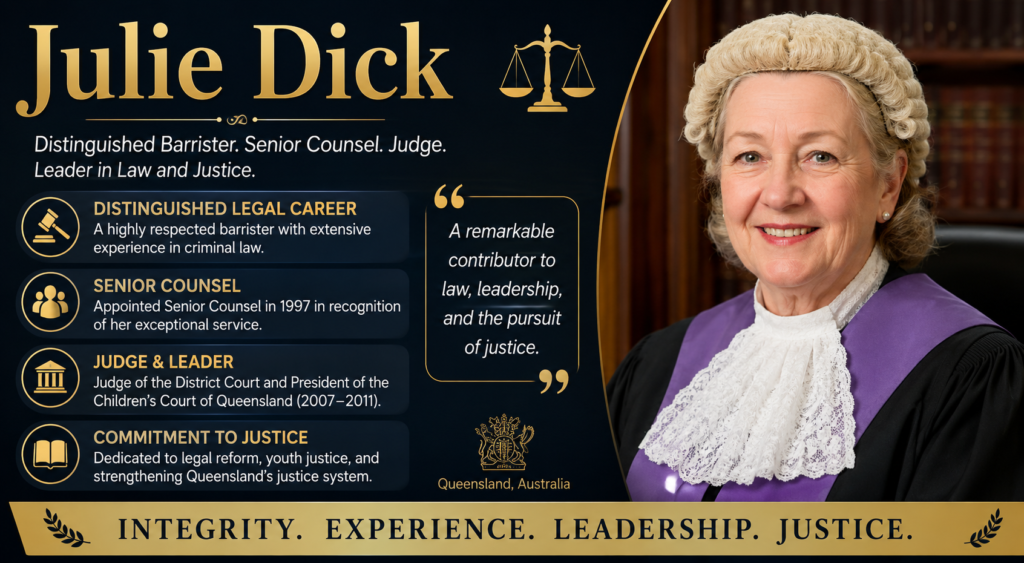
Julie Dick Julie Maree Dick was born in Brisbane, Queensland, Australia, in 1952. She grew up in a large family as one of nine children. Her childhood was spent in an environment that encouraged learning, responsibility, and personal growth. These early experiences helped shape the determination and work ethic that would later define her legal career. (AWR)
As a young girl, Julie moved with her family to the Gold Coast. The region was experiencing significant development during that period, creating opportunities and exposing her to a rapidly changing society. Growing up in such an environment allowed her to witness different social and economic realities from an early age. (AWR)
Her academic abilities became evident during her school years. Teachers recognized her intelligence and commitment to learning, and she consistently performed well in her studies. These qualities would eventually lead her toward a profession that demanded analytical thinking and intellectual discipline. (AWR)
Education and the Path Toward Law
Julie Dick’s interest in law did not emerge by accident. During her early adult years, she became increasingly fascinated by the legal profession and the courtroom environment. She began working as an articled clerk in a legal practice, where she gained firsthand experience of how the justice system operated. (AWR)
The practical exposure she received during this period proved invaluable. Rather than simply studying legal concepts in textbooks, she witnessed real legal disputes, client interactions, and courtroom proceedings. This practical knowledge helped strengthen her confidence and deepen her understanding of legal practice. (AWR)
Eventually, she completed the necessary legal training and successfully passed the Bar examinations. In December 1975, she was admitted as a barrister, marking the beginning of a career that would span several decades and leave a significant impact on Queensland’s legal system. (AWR)
Building a Successful Career at the Bar
Starting a career as a barrister can be challenging, particularly during a period when relatively few women worked in the profession. Julie Dick entered the legal field at a time when female representation in senior legal positions was limited. Despite these obstacles, she remained focused on developing her expertise. (AWR)
Criminal law quickly became her primary area of practice. She was drawn to the complexity of criminal trials, the strategic nature of courtroom advocacy, and the importance of ensuring justice. Over time, she developed a reputation for meticulous preparation and persuasive advocacy. (AWR)
Her legal career flourished as she appeared in numerous significant cases. She participated in nearly fifty murder trials and handled many other complex criminal matters involving serious offenses. These experiences established her as one of Queensland’s most respected criminal lawyers. (AWR)
Overcoming Challenges as a Woman in Law
Julie Dick’s career is also a story of perseverance. When she entered the legal profession, women faced barriers that many younger lawyers today may not fully appreciate. Female barristers often struggled to secure opportunities and gain recognition in a male-dominated environment. (AWR)
Rather than allowing these challenges to limit her ambitions, Julie focused on delivering exceptional work. She built credibility through preparation, professionalism, and courtroom success. Her growing reputation gradually opened doors that had previously been difficult for women to access. (AWR)
Her achievements helped demonstrate that success in the legal profession should be based on talent and dedication rather than gender. As a result, she became an important role model for future generations of female lawyers and legal professionals. (AWR)
Appointment as Senior Counsel and Judge
A major milestone in Julie Dick’s career came when she was appointed Senior Counsel in 1997. This recognition reflected her extensive legal experience and standing within the profession. Achieving Senior Counsel status is considered one of the highest professional honors for practicing barristers. (AWR)
Her leadership abilities extended beyond courtroom advocacy. She participated in legal reform initiatives and served on various committees that examined improvements to criminal law and legal procedures. These roles allowed her to contribute to the broader development of the justice system. (AWR)
In December 2000, she was appointed as a judge of the District Court of Queensland. This appointment represented the culmination of years of distinguished legal service and reflected the confidence that the legal community had in her judgment and expertise. (AWR)
Leadership in the Children’s Court
One of the most notable aspects of Julie Dick’s judicial career was her involvement with the Children’s Court. In 2001, she became a judge of the Children’s Court of Queensland, taking on responsibilities that required both legal knowledge and sensitivity toward young people. (AWR)
Working within the Children’s Court exposed her to complex social issues affecting youth. She often encountered cases involving vulnerable children and families facing difficult circumstances. Her work highlighted the importance of balancing accountability with rehabilitation and support. (AWR)
From 2007 to 2011, she served as President of the Children’s Court of Queensland. During this period, she played a leadership role in shaping court practices and promoting effective approaches to youth justice. Her contributions strengthened the court’s ability to address challenges facing young offenders and vulnerable children. (AWR)
Contributions to Legal Reform and Public Service
Beyond her judicial duties, Julie Dick made significant contributions to legal reform and public administration. She served on the Law Reform Commission’s Criminal Law Subdivision and participated in the review of Queensland’s Criminal Code. These efforts helped ensure that laws remained relevant and effective in a changing society. (AWR)
She also became the inaugural Parliamentary Criminal Justice Commissioner, a role that involved oversight, accountability, and investigation of issues related to the criminal justice system. This position required independence, integrity, and a thorough understanding of legal processes. (AWR)
Her work in these areas demonstrated that legal professionals can influence justice not only through courtroom decisions but also through policy development and institutional reform. By participating in these initiatives, she contributed to long-term improvements within Queensland’s legal framework. (AWR)
Legacy and Lasting Influence
Julie Dick’s legacy extends far beyond individual cases or judicial appointments. She represents the values of dedication, professionalism, and public service that are essential to a strong legal system. Her career illustrates how commitment to justice can create meaningful change over time. (AWR)
Young lawyers often look to accomplished figures like Julie Dick for inspiration. Her journey shows that success requires persistence, continuous learning, and a willingness to embrace challenges. Her achievements remain a powerful example for women pursuing careers in law and public service. (AWR)
Even today, her contributions continue to be recognized within legal circles. Through her work as a barrister, senior counsel, judge, and legal reform advocate, she has left a lasting mark on Queensland’s justice system and on the broader legal profession. (AWR)
Conclusion
Julie Dick’s story is one of determination, achievement, and service. From her early years in Queensland to her rise as one of the state’s respected legal figures, she built a career characterized by excellence and integrity. Her work in criminal law, judicial leadership, and legal reform reflects a lifelong commitment to justice. (AWR)
What makes her journey particularly inspiring is her ability to succeed in a demanding profession while helping shape important legal institutions. Her accomplishments continue to serve as an example of what can be achieved through dedication and hard work. (AWR)
As the legal profession continues to evolve, the contributions of Julie Dick remain relevant and influential. Her legacy stands as a reminder that strong leadership and a commitment to fairness can have a lasting impact on society and the justice system alike. (AWR)
You May Read Also:

