

Introduction
Few novels have managed to stay as Brave New World Book Review relevant across generations as Brave New World by Aldous Huxley. First published in 1932, the book imagined a future where technology, scientific control, and engineered happiness replace individuality, freedom, and genuine human emotion. Decades later, many readers still find themselves comparing Huxley’s fictional society with the modern world.
What makes this novel stand out is not just its creative vision of the future but the questions it raises about humanity. Instead of relying on dramatic wars or catastrophic disasters, Huxley presents a society where people willingly surrender their independence in exchange for comfort and stability. That idea feels surprisingly believable even today. Brave New World Book Review
In this Brave New World book review, we’ll explore the story, characters, themes, writing style, strengths, weaknesses, and why the novel continues to be one of the most discussed works of dystopian literature.
Overview of Brave New World
Aldous Huxley sets the novel in a futuristic society where people are genetically engineered before birth and conditioned throughout childhood to fit predetermined social roles. Every aspect of life is controlled by the government, from careers and relationships to emotions and entertainment. Brave New World Book Review
The society believes that stability is more important than freedom. Citizens are encouraged to avoid deep emotional connections, consume products constantly, and use a drug called Soma whenever they experience discomfort. As a result, conflict is almost nonexistent, but genuine happiness is questionable. Brave New World Book Review
The story mainly follows Bernard Marx, Lenina Crowne, and John the Savage, whose different perspectives reveal the cracks beneath this seemingly perfect civilization. Through these characters, Huxley challenges readers to think about what truly makes life meaningful.
Plot Summary (Without Major Spoilers)
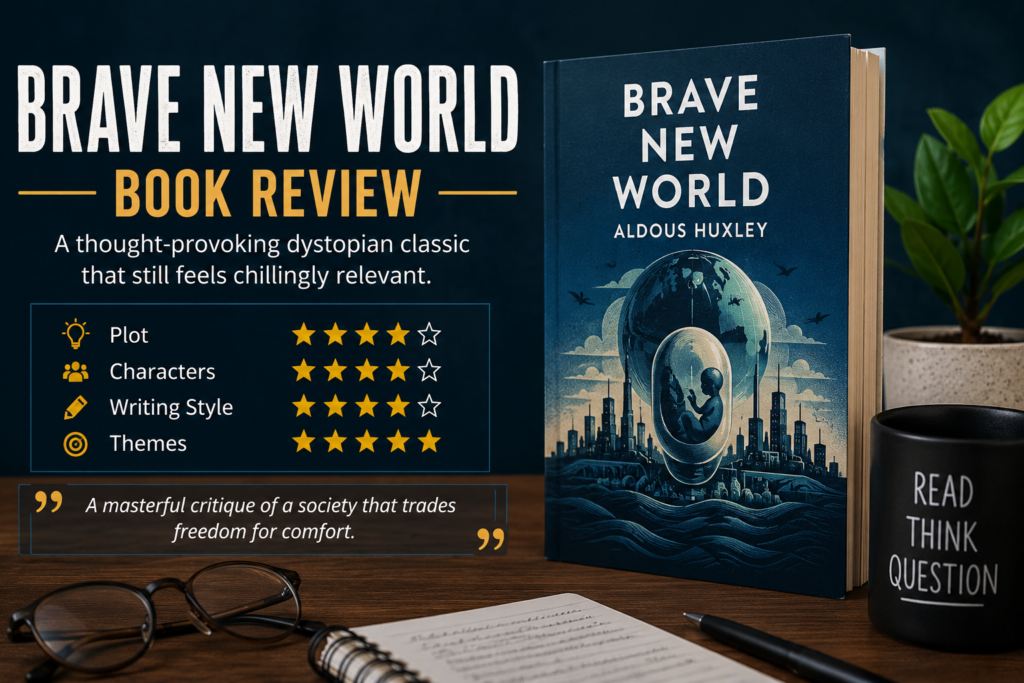
The novel begins by Brave New World Book Review introducing readers to the World State, where babies are produced in laboratories instead of natural birth. People are assigned to different social classes before they are even born, ensuring that society functions like a perfectly organized machine.
Bernard Marx, one of the main characters, feels disconnected from the society around him. Unlike everyone else, he questions the values that most citizens accept without hesitation. His curiosity eventually leads him to a Savage Reservation, where he meets John, a young man raised outside the controlled civilization. Brave New World Book Review
John’s arrival in the World State creates one of the novel’s most fascinating conflicts. His traditional understanding of love, family, religion, and morality clashes with a society that has abandoned those concepts entirely. This cultural collision drives much of the novel’s emotional and philosophical depth. Brave New World Book Review
The Major Themes That Make the Novel Timeless
Technology and Human Control
One of Huxley’s biggest concerns is how technology can be used to manipulate society rather than improve it. In Brave New World, science isn’t focused on helping individuals grow but on maintaining social order.
Citizens are designed before birth, psychologically conditioned throughout childhood, and constantly distracted by entertainment. Instead of using force, the government controls people by making them comfortable enough that they never question authority.
This theme feels especially relevant today as discussions about artificial intelligence, genetic engineering, social media algorithms, and digital surveillance continue to grow. While our world is very different from Huxley’s, some readers notice interesting similarities that encourage thoughtful discussion. Brave New World Book Review
Individuality vs. Conformity
The novel repeatedly asks whether individuality is worth preserving if it creates discomfort and conflict. The World State values sameness because predictable citizens are easier to manage. Brave New World Book Review
Characters like Bernard Marx and John the Savage struggle because they refuse to completely conform. Their desire to think independently highlights how difficult it becomes to remain unique in a society built around uniformity. Brave New World Book Review
Huxley never gives simple answers. Instead, he encourages readers to consider whether true happiness can exist without freedom to choose, fail, and experience emotional pain. Brave New World Book Review
Happiness at Any Cost
Perhaps the novel’s most famous idea is the use of Soma, a drug that removes sadness, anxiety, and emotional suffering. Rather than solving problems, people simply escape them. Brave New World Book Review
This raises an important philosophical question: Is happiness still meaningful if it comes from avoiding reality? Huxley suggests that emotional pain, while unpleasant, is an essential part of being human. Brave New World Book Review
The novel argues that love, grief, sacrifice, and ambition all contribute to a rich human experience. Eliminating suffering might also eliminate what gives life depth and purpose.
Character Analysis
Bernard Marx
Bernard initially appears to be a rebellious outsider who questions the values of his society. His insecurity and desire for acceptance make him a realistic and relatable character. Brave New World Book Review
However, as the story progresses, readers begin to notice that Bernard’s motivations are more complicated than they first seem. He often struggles between wanting independence and wanting social approval.
His flaws make him one of the novel’s most believable characters because he reflects the complexity of human nature rather than fitting neatly into the role of hero or villain. Brave New World Book Review
John the Savage
John serves as the emotional heart of the novel. Having grown up outside the World State, he represents traditional human values like love, family, religion, literature, and personal sacrifice.
His fascination with Shakespeare shapes much of his worldview, making him dramatically different from the emotionally detached citizens of the World State. Brave New World Book Review
John’s experiences allow readers to compare two completely different visions of civilization, making his character central to the novel’s philosophical debate.
Lenina Crowne
Lenina represents the average citizen of the World State. She follows social rules, embraces pleasure, and rarely questions authority.
Despite her conditioning, moments throughout the novel suggest that she possesses emotional complexity beneath the surface. These subtle hints make her more interesting than a simple symbol of conformity.
Her interactions with Bernard and John illustrate how difficult genuine relationships become in a society built around temporary pleasure rather than emotional commitment.
Writing Style and Literary Quality
Aldous Huxley’s writing is intelligent, descriptive, and filled with philosophical discussion. While the opening chapters can feel dense due to the amount of world-building, the story becomes increasingly engaging as readers understand how the society functions.
The dialogue often carries deeper meaning beyond the immediate conversation. Many scenes encourage readers to pause and reflect instead of simply following the plot.
Readers who enjoy thought-provoking literature will likely appreciate Huxley’s style. Those expecting fast-paced action may find parts of the novel slower, but the intellectual depth rewards patient reading.
What Makes Brave New World Different from Other Dystopian Novels?
Many dystopian stories portray governments maintaining control through fear, violence, or constant surveillance. Huxley imagined something different.
In Brave New World, people are controlled through pleasure rather than oppression. Citizens willingly participate in the system because they are comfortable, entertained, and conditioned from birth to avoid questioning authority.
This approach makes the novel especially memorable because it explores a form of control that appears gentle on the surface yet deeply limits personal freedom. Instead of chains or prison walls, the society uses comfort, consumerism, and instant gratification.
That unique perspective has helped the novel remain influential and sparked countless discussions among readers, scholars, and critics.
Strengths of the Book
One of the greatest strengths of Brave New World is its remarkable foresight. Although written nearly a century ago, many of its ideas still feel surprisingly relevant. Discussions about technology, consumer culture, mental health, and personal freedom continue to echo themes found throughout the novel.
The philosophical depth is another major advantage. Rather than presenting a simple battle between good and evil, Huxley encourages readers to examine difficult moral questions without offering easy answers.
The memorable world-building also deserves praise. Every element of the World State—from genetic engineering to psychological conditioning—works together to create a believable society that feels both fascinating and unsettling.
Weaknesses of the Book
Some modern readers may find the first few chapters overwhelming because they introduce many unfamiliar concepts in a short period. The extensive explanations can temporarily slow the pacing.
Certain characters receive less emotional development than readers might expect. Since Huxley’s primary focus is exploring ideas, some relationships feel secondary to the philosophical themes.
Additionally, readers looking for an action-packed narrative may find the novel slower than contemporary dystopian fiction. The emphasis remains on intellectual discussion rather than dramatic plot twists.
Who Should Read Brave New World?
This novel is ideal for readers who enjoy classic literature, philosophical fiction, political thought, and science fiction. It is particularly rewarding for those interested in exploring ethical questions surrounding technology and society.
Students often study the book because it encourages critical thinking about freedom, consumerism, government control, and human nature. Book clubs also find it an excellent choice because it generates meaningful discussion from multiple perspectives.
Even readers who rarely pick up classic novels may be surprised by how modern many of Huxley’s ideas feel. The themes continue to resonate in conversations about artificial intelligence, biotechnology, digital media, and social influence.
Final Verdict
Brave New World remains one of the most influential dystopian novels ever written because it challenges readers to reconsider the relationship between freedom and happiness. Instead of imagining a future ruled entirely by fear, Aldous Huxley presents a civilization where comfort itself becomes a powerful tool of control.
The novel is thoughtful, intellectually engaging, and filled with ideas that remain relevant decades after its publication. While its slower pace and philosophical discussions may not appeal to every reader, those willing to engage with its themes will discover a book that stays in their minds long after the final page.
Overall Rating: 4.8/5
If you’re searching for a classic novel that combines science fiction with deep social commentary, Brave New World is well worth reading. Its questions about technology, individuality, consumer culture, and the pursuit of happiness continue to spark discussion, making it a timeless work that deserves its reputation as one of the greatest dystopian novels ever written.
You May Read Also: Maps of Colonial New England

