

Introduction
Domain Hide the URL with Domain Forwarding Masking forwarding is a common feature offered by many domain registrars. It allows you to send visitors from one domain name to another without requiring them to manually type the destination address. One option that often creates confusion is domain forwarding with masking. Many people search for ways to “hide the URL” when forwarding a domain because they want visitors to continue seeing the original domain in the browser’s address bar.
Although masking can achieve that visual effect, it comes with important limitations. Modern websites, search engines, and browsers have evolved significantly, making masked forwarding less practical than it once was. Understanding how it works before enabling it can save you from SEO problems, broken website functionality, and poor user experience. Hide the URL with Domain Forwarding Masking
This guide explains what domain forwarding with masking is, how it works, when it makes sense, and the better alternatives available today.
What Is Domain Forwarding with Masking?
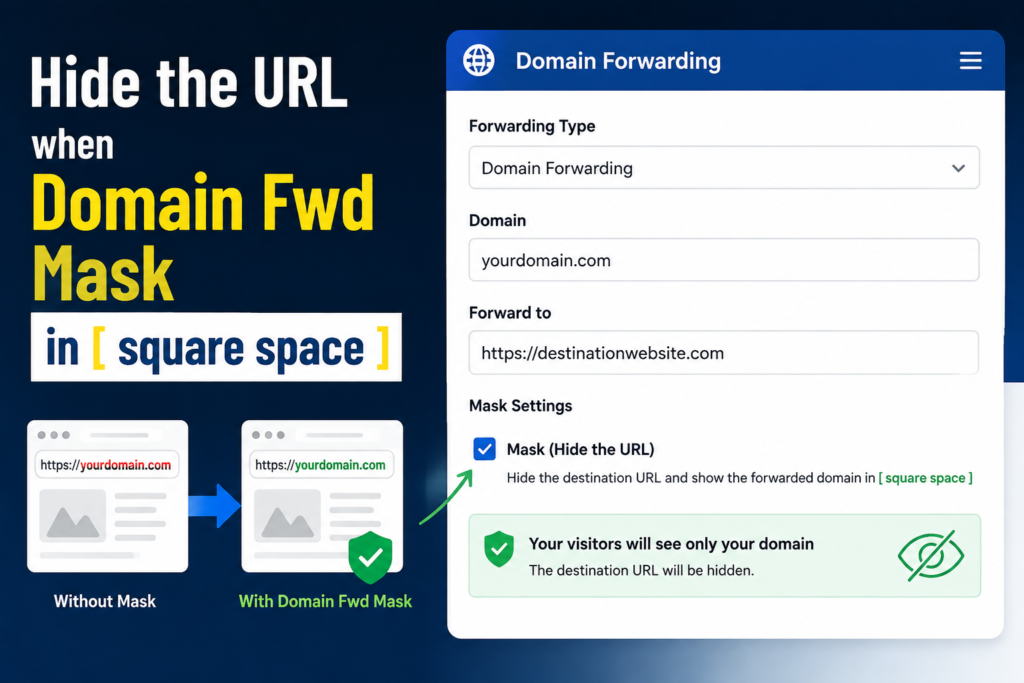
Domain forwarding with masking is a method of redirecting visitors while keeping the original domain visible in the browser’s address bar. Instead of displaying the actual destination URL, the forwarding service loads the destination website inside a hidden frame.
From a visitor’s perspective, they continue to see your domain even though the content actually comes from another website. This differs from a standard redirect, where the browser updates the address bar to the new URL. Hide the URL with Domain Forwarding Masking
Many domain registrars include masking as an optional feature alongside URL forwarding. When enabled, the forwarding system typically creates an HTML frameset or iframe that displays the destination website while preserving the original domain name.
Although this sounds convenient, many modern websites do not work properly inside frames. Security policies, JavaScript frameworks, and browser protections frequently prevent or limit framed content, making masked forwarding unreliable for many use cases.
How Domain Forwarding with Masking Works
When someone visits your domain, the forwarding service does not simply redirect them to another address. Instead, it generates a lightweight webpage that contains a frame pointing to the destination website. Hide the URL with Domain Forwarding Masking
The browser loads this frame while continuing to display your original domain in the address bar. As a result, visitors think they are still browsing your domain even though the actual content comes from elsewhere.
Because of this approach, the browser never truly navigates to the destination URL. Instead, it stays on the forwarding page while displaying the external website inside the embedded frame.
This technical difference explains why masked forwarding often causes issues with navigation, sharing links, browser history, analytics, and search engine indexing. Hide the URL with Domain Forwarding Masking
Why People Want to Hide the Destination URL
Many Hide the URL with Domain Forwarding Masking website owners register multiple domain names for branding purposes. Instead of building separate websites, they simply forward the extra domains to their primary website.
Some businesses also purchase easy-to-remember domains for advertising campaigns. Keeping the shorter domain visible can make printed marketing materials look cleaner and easier to remember.
Others use masked forwarding because they want affiliate pages, portfolio sites, or landing pages to appear under their own branded domain. While the intention is usually branding, masking is generally not the best solution today.
It is important to distinguish branding from deception. Using masking to mislead visitors about where they are browsing is inappropriate and can damage user trust. Hide the URL with Domain Forwarding Masking
Advantages of Domain Forwarding with Masking
One noticeable advantage is branding consistency. Visitors continue seeing your preferred domain throughout their session, creating a more unified appearance.
Another benefit is simplicity. Many registrars allow masked forwarding to be configured within minutes without requiring hosting, coding knowledge, or server administration. Hide the URL with Domain Forwarding Masking
Masked forwarding may also be suitable for very simple websites containing only a single page with minimal navigation. In these limited situations, functionality problems are less likely to appear.
However, these advantages should always be weighed against the significant disadvantages discussed below. Hide the URL with Domain Forwarding Masking
Common Problems with Masked Forwarding
The biggest issue is search engine optimization. Search engines generally prefer direct access to website content. Since masked forwarding relies on frames, indexing becomes more difficult and can reduce search visibility.
Navigation is another major concern. Visitors cannot easily bookmark specific pages because the browser continues displaying the same domain regardless of which internal page they visit. Hide the URL with Domain Forwarding Masking
Sharing links also becomes inconvenient. If someone copies the URL from the address bar, they may only copy the masked homepage instead of the exact content they intended to share.
Modern websites frequently use JavaScript applications, dynamic routing, authentication systems, cookies, and security headers that do not function correctly inside frames. This can lead to broken menus, failed logins, or incomplete page loading.
SEO Considerations You Should Know
Search engines have become much better at understanding website structure, canonical URLs, redirects, and user experience. Masked forwarding does not align well with these modern practices.
When search engine crawlers encounter framed content, they may struggle to determine which page should receive indexing and ranking signals. This uncertainty can negatively affect visibility.
Duplicate content concerns may also arise because multiple domains appear to serve the same content without proper canonical handling.
For websites that depend on organic traffic, a standard 301 redirect is usually a far better solution because it clearly tells search engines where the content has permanently moved. Hide the URL with Domain Forwarding Masking
Better Alternatives to Masked Forwarding
If your goal is simply to send visitors to another website, use a 301 permanent redirect. This method updates the browser address bar, preserves SEO signals more effectively, and is supported across all modern browsers.
If you own multiple domains for branding purposes, redirect secondary domains to your primary website rather than masking them. Visitors will still reach the correct destination without compatibility issues.
For businesses that want multiple branded domains while serving the same content, reverse proxy solutions or proper website hosting configurations are often more reliable than masked forwarding. Hide the URL with Domain Forwarding Masking
If you need several landing pages under different domains, creating dedicated websites or subdomains usually produces a better user experience and stronger search engine performance. Hide the URL with Domain Forwarding Masking
When Masked Forwarding May Still Be Appropriate
Although it is no longer recommended for most websites, masked forwarding can still be acceptable in a few limited situations.
A temporary marketing campaign with a single landing page may function adequately if the destination website supports framing and does not rely heavily on advanced browser features. Hide the URL with Domain Forwarding Masking
Internal testing environments may also benefit from masked forwarding when SEO and public usability are not important considerations.
Some organizations use masking for demonstration purposes or internal presentations where the audience only needs temporary access to a specific page.
Even in these cases, testing across multiple browsers and devices is essential before relying on masked forwarding. Hide the URL with Domain Forwarding Masking
Best Practices for Domain Forwarding
If you decide to use forwarding, keep these recommendations in mind:
- Use a 301 redirect whenever possible.
- Avoid masking for websites that depend on SEO.
- Test your website on desktop and mobile devices.
- Verify that login pages, forms, and navigation function correctly.
- Keep branding transparent and avoid misleading visitors.
- Monitor analytics after implementing forwarding.
- Use HTTPS on every domain involved in the forwarding process.
Following these practices helps ensure visitors enjoy a consistent experience while minimizing technical complications.
Frequently Asked Questions
Does masked forwarding improve SEO?
No. In most cases, masked forwarding is less SEO-friendly than a standard 301 redirect because search engines prefer direct access to website content.
Will visitors notice the destination website?
They will typically continue seeing your original domain in the address bar, but the destination website is loaded inside a frame, which can sometimes reveal itself through browser behavior or website functionality. Hide the URL with Domain Forwarding Masking
Can all websites be masked?
No. Many websites prevent framing through modern security headers or browser protections, causing masked forwarding to fail or display errors.
Is masked forwarding secure?
The forwarding itself is not inherently insecure, but framed websites may encounter security restrictions, authentication problems, or compatibility issues depending on how the destination site is configured.
What is the recommended alternative?
For nearly every modern website, a permanent 301 redirect is the preferred solution because it offers better compatibility, usability, and search engine support.
Conclusion
Domain forwarding with masking was once a convenient way to keep a branded domain visible while displaying content hosted elsewhere. However, the modern web has largely moved beyond this technique. Today’s websites rely on advanced security features, dynamic applications, and search engine optimization practices that often conflict with masked forwarding.
If your objective is branding, there are usually better solutions than hiding the destination URL. Standard redirects, reverse proxies, or properly hosted websites provide a more reliable experience for both visitors and search engines.
Before enabling masked forwarding, carefully evaluate whether its visual benefits outweigh its technical drawbacks. For most website owners, choosing a modern forwarding strategy will result in better performance, improved SEO, and a smoother user experience.
You May Read Also:

