

Introduction
The IB SEHS IA new rubric has become an important topic among International Baccalaureate (IB) students taking Sports, Exercise, and Health Science (SEHS). Since the Internal Assessment (IA) contributes significantly to the final grade, understanding the updated rubric can make a noticeable difference in both the quality of your investigation and your overall performance.
Many students focus heavily on collecting data and writing lengthy reports but overlook what the examiners are actually looking for. The new rubric shifts the emphasis toward demonstrating scientific thinking, logical investigation design, and meaningful analysis rather than simply presenting large amounts of information. This means every section of your IA should serve a clear purpose and contribute to answering your research question. IB SEHS IA New Rubric
In this guide, we’ll explore the IB SEHS IA new rubric, discuss its major assessment areas, explain what examiners expect, share practical writing tips, and highlight common mistakes to avoid. Whether you’re just beginning your IA or revising your final draft, this article will help you understand the updated expectations with confidence.
What Is the IB SEHS IA?
The Internal Assessment (IA) is an individual scientific investigation completed by every student taking IB Sports, Exercise, and Health Science. Unlike external exams, the IA allows students to investigate a topic that genuinely interests them while applying scientific methods learned throughout the course. IB SEHS IA New Rubric
Students are expected to formulate a focused research question, collect original data, analyze their findings, and evaluate both the strengths and limitations of their investigation. The project demonstrates not only scientific knowledge but also critical thinking, experimental design, and communication skills. IB SEHS IA New Rubric
The IA accounts for a substantial portion of the final course grade, making it one of the most important assignments in the curriculum. Because of this, understanding the IB SEHS IA new rubric is essential before planning your experiment.
Why Was the IB SEHS IA Rubric Updated?
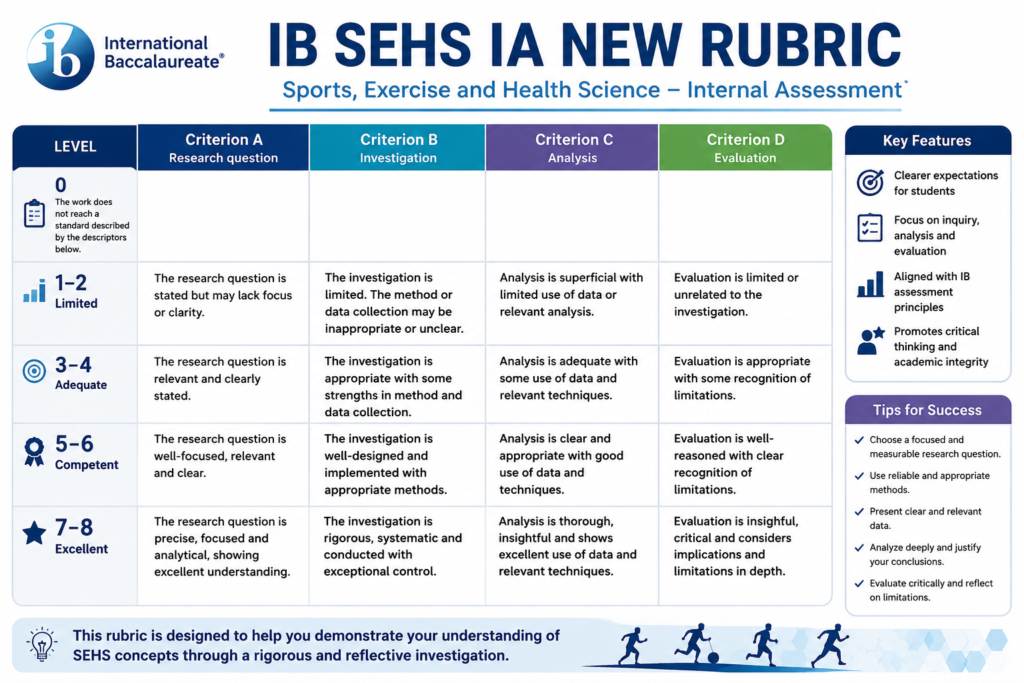
Educational IB SEHS IA new rubric assessments evolve over time to better reflect modern teaching methods and scientific practices. The updated rubric aims to make assessment more transparent while encouraging students to focus on genuine scientific inquiry rather than simply following a report template.
One of the biggest goals of the new rubric is consistency. Previous marking approaches sometimes allowed room for subjective interpretation, but the revised criteria provide clearer expectations for both teachers and examiners. Students now have a better understanding of what constitutes high-quality work. IB SEHS IA New Rubric
Another important change is the increased emphasis on evidence-based reasoning. Rather than rewarding lengthy descriptions, the rubric encourages concise explanations supported by scientific evidence, logical analysis, and thoughtful evaluation.
Understanding the Main Components of the IB SEHS IA New Rubric
Research Design
The investigation begins with a well-defined research question. Under the new rubric, students should ensure their research question is focused, measurable, and directly related to sports, exercise, or health science. IB SEHS IA New Rubric
A strong research design also includes identifying independent, dependent, and controlled variables. Examiners expect students to explain why these variables were selected and how they contribute to producing reliable results.
The methodology should be detailed enough for another researcher to replicate the investigation. Clear procedures, appropriate equipment, participant selection, and ethical considerations all contribute to a stronger score in this section. IB SEHS IA New Rubric
Data Collection
The updated rubric places significant importance on collecting relevant and accurate data. Students should gather enough observations to identify meaningful trends rather than relying on very small sample sizes.
Raw data should be presented clearly using organized tables with appropriate units and labels. Accuracy matters, and measurements should be recorded consistently throughout the investigation. IB SEHS IA New Rubric
Quality is valued over quantity. Instead of collecting unnecessary information, students should focus on data that directly answers their research question and supports meaningful analysis. IB SEHS IA New Rubric
Data Processing and Analysis
One of the strongest areas emphasized by the IB SEHS IA new rubric is data analysis. Students should move beyond describing results and instead explain what the findings actually mean.
Graphs, charts, and statistical calculations should be used when appropriate. Visual representations help examiners understand patterns and relationships more efficiently than large tables of numbers. IB SEHS IA New Rubric
Interpretation is equally important. Rather than stating that one result is higher than another, students should explain why the difference occurred using scientific principles from the SEHS syllabus.
Conclusion
A high-scoring conclusion directly answers the research question using evidence collected during the investigation. Students should avoid introducing new information at this stage.
The conclusion should discuss whether the hypothesis was supported and explain how the collected evidence justifies that conclusion. Linking findings back to scientific theory demonstrates a deeper understanding of the topic.
Examiners appreciate balanced conclusions that acknowledge both strengths and uncertainties instead of making exaggerated claims.
Evaluation
The evaluation section is often where top-performing students distinguish themselves. Instead of simply listing weaknesses, students should critically assess how limitations affected the reliability and validity of their investigation.
For example, participant fatigue, environmental conditions, equipment precision, or sample size may all influence results. Identifying these limitations demonstrates scientific awareness.
More importantly, each limitation should be paired with a realistic improvement. Rather than suggesting vague ideas like “collect more data,” explain exactly how increasing the sample size or improving equipment calibration would strengthen future investigations.
Key Differences in the New Rubric
The updated rubric encourages students to think like researchers rather than simply report experimental results. This means critical thinking is rewarded throughout the assessment.
Another noticeable difference is the stronger focus on justification. Every methodological choice should have a scientific reason behind it, from selecting participants to choosing statistical tests.
Communication has also become increasingly important. Reports should be logically organized, concise, and easy to follow. Clear headings, properly labeled figures, and consistent formatting help improve readability.
Tips for Scoring Highly Under the IB SEHS IA New Rubric
Before beginning your experiment, spend time developing a focused research question. A narrowly defined question usually leads to stronger investigations because it allows for more detailed analysis.
Use scientific terminology accurately throughout the report. Examiners expect students to demonstrate knowledge of physiological, biomechanical, or psychological concepts relevant to their investigation.
Collect reliable data by controlling variables as much as possible. Consistency during testing improves the credibility of your findings and makes your conclusions more convincing.
Support every conclusion with evidence. Whenever you make a claim, refer to specific results from your investigation rather than relying on assumptions.
Proofread your work carefully. Grammar mistakes, inconsistent formatting, and unclear explanations can reduce the overall professionalism of an otherwise excellent IA.
Common Mistakes Students Make
Many students choose research questions that are too broad. A focused question generally produces clearer results and allows for more meaningful analysis.
Another common mistake is describing results without interpreting them. The new rubric rewards explanation rather than observation. Always explain why your results occurred using scientific concepts.
Some students include unnecessary background information while neglecting evaluation. Although context is useful, the majority of marks come from demonstrating scientific investigation skills rather than writing lengthy introductions.
Poor graph formatting is another frequent issue. Axes should always be labeled correctly, units should be included, and graphs should be easy to interpret.
Finally, students sometimes provide generic improvements such as “increase accuracy.” Instead, explain exactly how accuracy could be improved and how that change would influence the reliability of future results.
How Teachers Use the New Rubric
Teachers use the rubric throughout the IA process, not just during final grading. Early feedback often focuses on refining research questions, improving methodology, and ensuring variables are properly controlled.
During drafting, teachers may encourage students to strengthen analysis by linking results to scientific theory. They also help identify areas where evidence does not fully support conclusions.
Because the IB uses moderation procedures, teachers aim to ensure that assessments align closely with official marking standards. Understanding the rubric yourself allows you to independently evaluate your work before submission.
Preparing Your IA from the Beginning
Planning ahead is one of the easiest ways to improve your final score. Rather than collecting data immediately, first design a method that directly answers your research question.
Create organized data tables before beginning the experiment. This helps ensure consistency and reduces the likelihood of recording errors during testing.
After collecting data, analyze it as soon as possible. Early analysis makes it easier to identify missing information or unexpected trends while the experiment is still fresh in your mind.
Finally, leave enough time for revisions. Reading your report several days after writing it often reveals areas where explanations can be clarified or strengthened.
Final Thoughts
The IB SEHS IA new rubric encourages students to develop genuine scientific investigation skills instead of simply producing lengthy reports. Success comes from asking a focused research question, designing a logical methodology, collecting reliable data, performing thoughtful analysis, and critically evaluating the entire investigation.
Rather than trying to impress examiners with unnecessary complexity, focus on clarity, accuracy, and evidence-based reasoning. Every section of your IA should contribute toward answering your research question in a logical and scientifically supported way.
Students who understand the rubric before beginning their investigation are far more likely to produce organized, analytical, and well-supported reports. By treating your IA as a real scientific study and consistently referring back to the assessment criteria, you’ll place yourself in the best possible position to achieve a strong score.
You May Read Also: Hydra MP9 Factory New

