

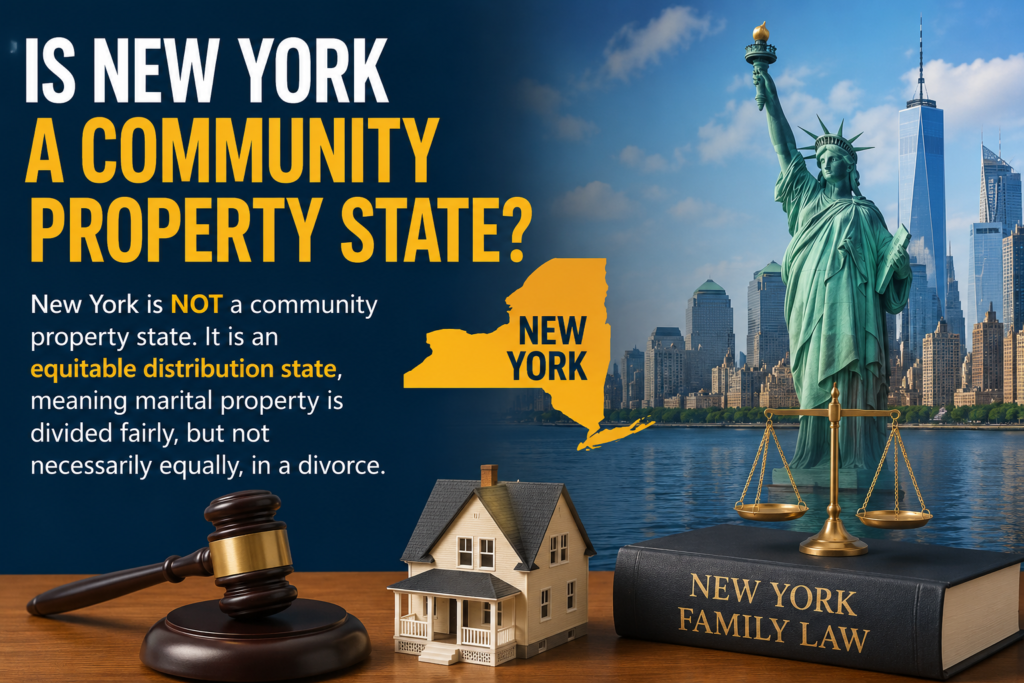
When people go through a divorce or start planning their estate, one legal question often comes up: Is New York a community property state The short answer is no. New York does not follow community property laws. Instead, it uses a legal system known as equitable distribution to divide marital assets during a divorce.
Although the answer seems straightforward, the way property is divided in New York is more nuanced than many people realize. Equitable distribution doesn’t always mean a 50/50 split, and understanding how it works can help couples make informed financial decisions before, during, and after marriage. Is New York a Community Property State
In this guide, we’ll explain everything you need to know about New York’s property division laws, how equitable distribution differs from community property, and what factors courts consider when dividing assets. Whether you’re preparing for marriage, considering a divorce, or simply curious about state property laws, this article provides a clear and practical overview. Is New York a Community Property State
Is New York a Community Property State?
The simple answer is no. New York is not one of the community property states in the United States. Instead, it follows the principle of equitable distribution, which focuses on dividing marital property fairly rather than equally. Is New York a Community Property State
Community property states generally consider most assets and debts acquired during marriage to belong equally to both spouses. In those states, courts often divide marital property 50/50 unless there’s a valid agreement stating otherwise. New York takes a different approach by allowing judges to determine what is fair based on the circumstances of each marriage.
This distinction is important because fairness doesn’t always mean an equal split. One spouse may receive a larger share of certain assets if the court determines that doing so would produce a more equitable outcome. Every divorce is unique, which is why New York courts examine multiple factors before making decisions. Is New York a Community Property State
Understanding Equitable Distribution in New York
Equitable distribution is the legal process used to divide marital property during divorce proceedings. The word “equitable” means fair, not necessarily equal.
New York courts evaluate the financial situation of both spouses before deciding how property should be divided. They consider contributions made throughout the marriage, future financial needs, and other relevant circumstances instead of automatically splitting everything down the middle. Is New York a Community Property State
For example, if one spouse paused their career to raise children while the other built a successful business, the court may recognize those non-financial contributions when distributing assets. The goal is to reach an outcome that reflects the realities of the marriage rather than relying on a strict mathematical formula. Is New York a Community Property State
What Counts as Marital Property?
Marital property Is New York a community property state generally includes assets and debts acquired by either spouse during the marriage, regardless of whose name appears on the title or account.
Common examples include: Is New York a Community Property State
- Family homes purchased during marriage
- Retirement savings earned while married
- Joint bank accounts
- Investment portfolios
- Vehicles
- Business interests developed during marriage
- Household furniture and valuable personal belongings
Even if only one spouse earned the income used to purchase these assets, they may still be considered marital property under New York law. Courts look beyond ownership documents and examine when and how the property was acquired.
Understanding what qualifies as marital property is one of the most important parts of any divorce because these assets are generally subject to equitable distribution. Is New York a Community Property State
What Is Separate Property?
Not everything owned by a married couple is divided during divorce. Certain assets remain the separate property of one spouse.
Separate property often includes assets owned before marriage, inheritances received individually, gifts specifically given to one spouse, and compensation for certain personal injury claims. Is New York a Community Property State
However, separate property can sometimes become marital property through a process known as commingling. For example, if inherited money is deposited into a joint bank account and used for family expenses, distinguishing between separate and marital property can become difficult. Is New York a Community Property State
Proper financial records can make a significant difference when proving that an asset should remain separate during divorce proceedings.
Factors Courts Consider During Property Division
New York judges don’t simply divide everything equally. Instead, they evaluate numerous factors to determine what distribution would be fair. Is New York a Community Property State
The length of the marriage often plays a major role. Long-term marriages may result in different outcomes than short-term marriages because spouses have generally become more financially intertwined over time.
Courts also consider each spouse’s income, earning capacity, health, age, future financial needs, and contributions to the marriage. Contributions aren’t limited to earning money. Raising children, maintaining the household, and supporting a spouse’s career are all valuable contributions recognized under New York law. Is New York a Community Property State
In some cases, judges may also consider tax consequences, wasteful spending of marital assets, or other financial behavior that affected the marital estate. Is New York a Community Property State
Community Property States vs. Equitable Distribution States
Many people confuse these two legal systems because both involve dividing assets during divorce. However, the methods differ significantly.
Community property states generally presume that assets accumulated during marriage belong equally to both spouses. Unless exceptions apply, each spouse typically receives half of the marital property.
Equitable distribution states like New York focus on fairness rather than equality. Courts have greater flexibility to tailor property division based on the facts of each individual case.
Neither system is necessarily better than the other. Each reflects different legal philosophies about marriage, ownership, and financial fairness.
Can Couples Decide Their Own Property Division?
Yes. Many couples avoid lengthy court battles by negotiating their own property settlement agreements.
When both spouses reach a voluntary agreement regarding asset division, debts, retirement accounts, and real estate, courts generally approve those agreements as long as they’re fair and comply with legal requirements.
Prenuptial and postnuptial agreements also allow couples to establish property rights before or during marriage. These agreements can specify how assets will be divided if the marriage ends, reducing uncertainty and potential conflict later.
Creating clear legal agreements often saves time, money, and emotional stress if divorce eventually occurs.
How Debts Are Divided in New York
Property isn’t the only issue during divorce. Debts accumulated during marriage must also be allocated fairly.
Mortgages, credit card balances, vehicle loans, personal loans, and other financial obligations may all be considered marital debts depending on when and why they were incurred.
Just like assets, debts aren’t automatically split equally. Courts examine who benefited from the debt, each spouse’s financial circumstances, and the overall fairness of assigning responsibility.
For example, business debts related to one spouse’s company may not always be divided the same way as household debts that benefited the entire family.
Why Legal Advice Matters
Although understanding the basics of equitable distribution is helpful, every divorce presents unique legal and financial issues.
High-value assets, retirement accounts, family businesses, stock options, inheritances, and real estate investments often require detailed financial analysis. Small differences in valuation can significantly affect the outcome.
An experienced family law attorney can help identify marital assets, protect separate property claims, negotiate settlements, and explain how New York law applies to a specific situation. Professional guidance becomes especially valuable when substantial assets or complex finances are involved.
Even couples pursuing an uncontested divorce often benefit from legal advice to ensure agreements accurately reflect their intentions.
Common Misconceptions About New York Property Laws
One common misconception is that everything is automatically divided 50/50 during divorce. In reality, New York law focuses on fairness, not equal percentages.
Another misunderstanding is that assets titled in only one spouse’s name always remain that spouse’s property. Ownership documents are important, but they don’t always determine whether an asset is marital or separate.
Some people also believe that stay-at-home spouses have fewer property rights because they didn’t earn income. New York courts recognize that raising children, managing the household, and supporting a spouse’s career are valuable contributions deserving of consideration during equitable distribution.
Understanding these distinctions helps people approach divorce with more realistic expectations.
Final Thoughts
So, is New York a community property state? The answer is no. New York follows the principle of equitable distribution, meaning marital property is divided fairly rather than automatically split down the middle.
This system gives courts flexibility to consider the unique circumstances of every marriage, including financial contributions, caregiving responsibilities, future earning potential, and many other factors. As a result, two divorces with similar assets may produce very different outcomes depending on the facts involved.
Whether you’re planning your financial future, entering marriage, or facing divorce, understanding how New York handles property division is an important step toward making informed decisions. Knowing the difference between community property and equitable distribution can help you better protect your interests and navigate the legal process with greater confidence.
You May Read Also:

