

New Jersey: Can a Trailer Be Liable for a Tractor Commercial truck accidents are often far more complex than standard car crashes, especially when they involve a tractor-trailer combination. One question that occasionally arises is: Can a trailer be liable for a tractor in New Jersey? While a trailer itself is not a legal person or entity capable of being “liable,” the companies or individuals responsible for owning, maintaining, loading, or leasing the trailer may share legal responsibility for an accident.
Understanding how liability works in New Jersey is important for truck drivers, fleet owners, businesses, and accident victims alike. Since commercial trucking often involves multiple parties, determining who is responsible requires a detailed investigation into the equipment, maintenance records, contracts, and the circumstances of the crash. New Jersey: Can a Trailer Be Liable for a Tractor
This guide explains how trailer-related liability works under New Jersey law, what factors investigators consider, and why liability often extends beyond the truck driver.
Understanding the Difference Between a Tractor and a Trailer
A tractor is the powered vehicle that contains the engine and is operated by the driver. It is designed to pull a trailer, which is an unpowered unit used to transport cargo. Although they function together, they are often owned by different companies.
Many trucking operations lease trailers from one company while using tractors owned by another. In some situations, the cargo belongs to a completely different business. This creates multiple parties that may become involved when an accident occurs.
The separation of ownership is one reason trucking accident claims are more complicated than ordinary vehicle accidents. Each party has different legal responsibilities, and investigators must determine whether any of them contributed to the incident.
Can a Trailer Be Legally Liable?
The simple answer is no. A trailer itself cannot be held legally liable because it is not a legal entity. However, the trailer’s owner, maintenance provider, leasing company, manufacturer, or cargo-loading company may be held responsible if their actions or negligence contributed to an accident.
For example, if poorly maintained brakes on the trailer fail while traveling on a New Jersey highway, investigators may determine that the company responsible for maintaining the trailer acted negligently.
Similarly, if improperly loaded cargo shifts during transport, causing the driver to lose control, the company responsible for loading the trailer could share liability. New Jersey: Can a Trailer Be Liable for a Tractor
Therefore, when people ask whether “the trailer is liable,” they usually mean whether someone connected to the trailer may bear legal responsibility.
Situations Where Trailer Owners May Share Liability
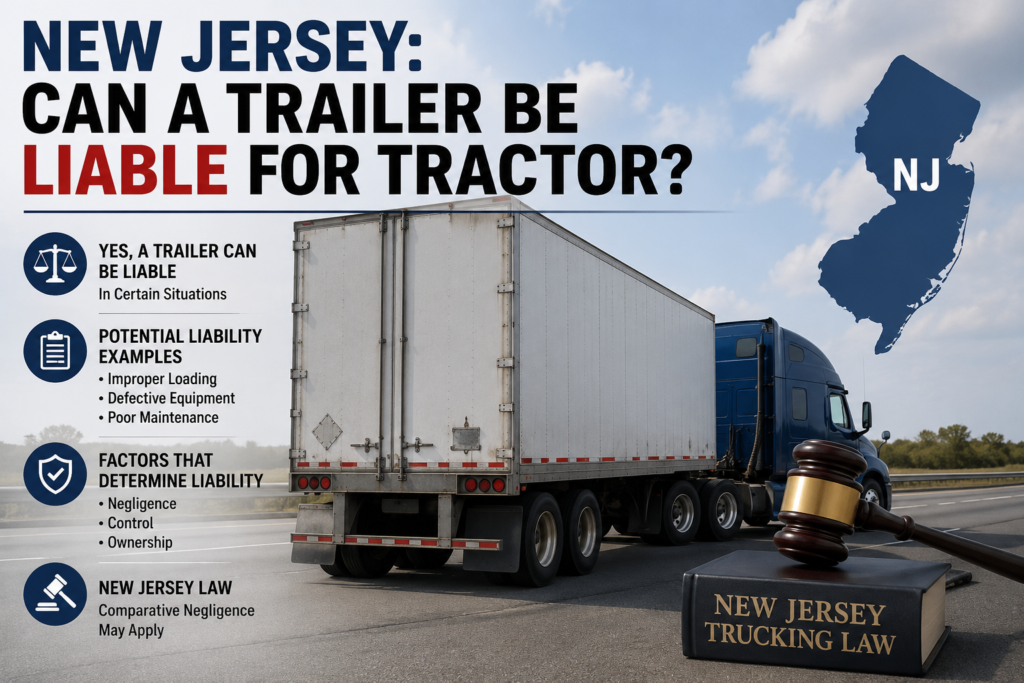
Trailer owners trailer be liable for a tractor in New Jersey have a duty to keep their equipment in reasonably safe operating condition. Failing to inspect or repair critical components can create dangerous conditions for everyone on the road.
One common issue involves defective tires. A worn or damaged trailer tire may suddenly blow out, causing the truck to jackknife or overturn. If maintenance records reveal neglected inspections, the trailer owner could face liability. New Jersey: Can a Trailer Be Liable for a Tractor
Brake failures are another major concern. Commercial trailers rely on properly functioning braking systems, and neglected maintenance may significantly increase stopping distances.
Broken lighting systems also create hazards. Missing brake lights or turn signals reduce visibility and increase the likelihood of rear-end collisions, particularly during nighttime driving. New Jersey: Can a Trailer Be Liable for a Tractor
The Importance of Proper Cargo Loading
Cargo loading plays a significant role in trucking safety. Even if both the tractor and trailer are mechanically sound, improperly loaded freight can create dangerous driving conditions. New Jersey: Can a Trailer Be Liable for a Tractor
Uneven weight distribution may cause the trailer to sway or roll over during turns. Overloaded trailers place excessive stress on braking systems and tires, increasing the risk of mechanical failure.
Loose cargo can shift while traveling, suddenly changing the trailer’s center of gravity. In severe cases, cargo may even spill onto the roadway, creating hazards for surrounding vehicles. New Jersey: Can a Trailer Be Liable for a Tractor
When third-party loading companies fail to follow federal cargo securement standards, they may become partially responsible for resulting accidents.
Maintenance Responsibilities Matter
Commercial trailers require regular inspections and preventive maintenance. New Jersey trucking companies generally follow both state regulations and federal safety standards established for commercial motor vehicles.
Routine inspections include checking: New Jersey: Can a Trailer Be Liable for a Tractor
- Brake systems
- Suspension components
- Tires
- Wheels
- Electrical wiring
- Reflective markings
- Coupling devices
- Air brake systems
Skipping scheduled maintenance may create evidence of negligence if an accident occurs. Maintenance records often become key evidence during insurance claims and lawsuits. New Jersey: Can a Trailer Be Liable for a Tractor
Professional investigators frequently review repair logs to determine whether known defects were ignored before the collision.
When the Tractor Driver Is Also Responsible
Even when trailer-related problems contribute to an accident, the tractor driver may still share liability.
Drivers are expected to perform pre-trip inspections before operating commercial vehicles. If obvious safety defects are present and the driver chooses to continue driving, that decision may contribute to legal responsibility.
Drivers must also ensure the trailer is properly connected before entering public roads. An improperly secured coupling can cause the trailer to detach, leading to catastrophic accidents. New Jersey: Can a Trailer Be Liable for a Tractor
Additionally, speeding, distracted driving, fatigue, or impaired driving may combine with trailer defects to create dangerous situations.
Because multiple factors often contribute to trucking accidents, liability is frequently shared among several parties. New Jersey: Can a Trailer Be Liable for a Tractor
The Role of Trucking Companies
Employers may also bear responsibility under legal principles that hold businesses accountable for the actions of employees performing their job duties.
Trucking companies are responsible for hiring qualified drivers, providing adequate training, enforcing safety policies, and maintaining their fleets.
Some companies unfortunately prioritize delivery schedules over maintenance. Delayed repairs or unrealistic delivery deadlines may encourage unsafe driving practices. New Jersey: Can a Trailer Be Liable for a Tractor
Investigators may examine company records to determine whether management ignored safety concerns or violated industry regulations.
Poor hiring practices, inadequate supervision, or failure to comply with maintenance requirements can all increase a trucking company’s exposure to liability. New Jersey: Can a Trailer Be Liable for a Tractor
Defective Trailer Parts and Manufacturer Liability
Not every trailer accident results from poor maintenance. Sometimes the problem originates during manufacturing.
Defective brake components, faulty coupling devices, damaged axles, or improperly manufactured suspension systems may fail even when maintenance has been performed correctly. New Jersey: Can a Trailer Be Liable for a Tractor
In these situations, the manufacturer or supplier of defective components may become involved in the legal process.
Product liability cases require technical investigations to determine whether the defect existed before the equipment entered service.
Expert engineers often inspect damaged trailers to identify manufacturing defects that contributed to the accident.
How Liability Is Determined in New Jersey
Determining liability involves collecting and analyzing substantial evidence. New Jersey: Can a Trailer Be Liable for a Tractor
Investigators typically review accident scene photographs, police reports, maintenance logs, driver qualification files, inspection records, electronic logging device data, black box information, surveillance footage, and witness statements.
The trucking industry’s extensive recordkeeping requirements often provide valuable evidence regarding maintenance schedules and operational practices. New Jersey: Can a Trailer Be Liable for a Tractor
Insurance companies may conduct their own investigations, but independent experts are often necessary to evaluate whether trailer defects contributed to the crash.
Because every accident has unique circumstances, liability cannot be determined solely by identifying which vehicle was involved.
Comparative Negligence in New Jersey
New Jersey follows a modified comparative negligence rule. New Jersey: Can a Trailer Be Liable for a Tractor
This means more than one party may share responsibility for an accident. If several parties contributed to the crash, each may be assigned a percentage of fault.
For example, a trucking company might bear responsibility for poor maintenance, while the driver could also be responsible for speeding. A cargo-loading company might share liability if improperly secured freight made the accident worse.
This system allows courts and insurance companies to evaluate each party’s contribution based on available evidence rather than placing blame on only one individual or business. New Jersey: Can a Trailer Be Liable for a Tractor
Evidence That May Support a Trailer-Related Claim
Successful truck accident investigations often rely on detailed documentation.
Important evidence may include maintenance records showing overdue inspections, repair invoices, inspection reports, driver inspection logs, electronic brake system data, cargo manifests, weight tickets, loading records, photographs of damaged equipment, and expert mechanical evaluations. New Jersey: Can a Trailer Be Liable for a Tractor
Modern commercial vehicles also contain electronic systems that record speed, braking activity, and other operational information before a collision.
Preserving this evidence quickly is important because some records may only be retained for limited periods under company policies or applicable regulations.
Why These Cases Are More Complex Than Typical Car Accidents
Unlike passenger vehicle crashes, commercial trucking accidents frequently involve multiple insurance policies, several business entities, independent contractors, maintenance vendors, manufacturers, and leasing companies.
A single tractor-trailer may involve one company owning the tractor, another owning the trailer, a third transporting the cargo, and a fourth responsible for loading it.
Because responsibility may be divided among several parties, determining liability requires careful legal and technical analysis.
This complexity is one reason commercial trucking claims often take longer to investigate than ordinary automobile accidents.
Final Thoughts
So, can a trailer be liable for a tractor in New Jersey? Technically, no—a trailer cannot be legally liable because it is simply a piece of equipment. However, the people and organizations connected to that trailer—including its owner, maintenance provider, leasing company, cargo loader, or even its manufacturer—may share legal responsibility if their negligence contributed to an accident.
Every tractor-trailer collision presents a unique set of facts. Equipment condition, cargo securement, driver behavior, maintenance history, ownership arrangements, and federal safety compliance all influence how liability is determined.
Understanding these relationships helps explain why commercial truck accident investigations are often detailed and involve multiple parties. Whether the issue involves defective equipment, improper loading, inadequate maintenance, or driver error, identifying the true source of negligence is essential to determining legal responsibility under New Jersey law.
You May Read Also: New Jazz Poroduction Kit

