

3PL New Warehouse Expanding 2026 The logistics industry is entering an important phase in 2026 as businesses continue looking for faster, more flexible, and more cost-effective ways to manage inventory and fulfillment. One of the biggest trends attracting attention is the expansion of 3PL new warehouse facilities. Third-party logistics providers are investing in additional warehouse space, technology, automation, and strategically located distribution centers to keep up with changing customer expectations.
The growth of e-commerce has played a major role in this transformation, but it is not the only factor. Manufacturers, retailers, wholesalers, subscription businesses, and direct-to-consumer brands are also relying on 3PL companies to manage storage and order fulfillment. Instead of building and operating their own warehouses, many companies prefer to work with logistics partners that already have the infrastructure and expertise in place. 3PL New Warehouse Expanding 2026
The phrase “3PL new warehouse expanding 2026” reflects a broader shift in the supply chain industry. Companies are no longer viewing warehouses simply as large buildings where products sit until they are shipped. Modern warehouses are becoming technology-driven fulfillment centers designed to process orders quickly, improve inventory accuracy, and give businesses the flexibility to respond to changing demand. 3PL New Warehouse Expanding 2026
Why 3PL Warehouses Are Expanding in 2026
One of the biggest reasons behind 3PL warehouse expansion is the continued demand for efficient fulfillment. Customers have become accustomed to having products delivered quickly, and businesses need reliable logistics operations to meet those expectations. A company may have an excellent product, but slow fulfillment or inaccurate deliveries can still damage customer satisfaction.
For many businesses, operating a private warehouse is expensive and complicated. Companies have to pay for property, employees, equipment, software, maintenance, insurance, utilities, and transportation management. A 3PL provider can spread many of these costs across multiple customers, making professional logistics services more accessible. 3PL New Warehouse Expanding 2026
Expansion also allows 3PL companies to serve customers in more regions. A warehouse located closer to major population centers can reduce transportation distances and potentially improve delivery times. As businesses compete on convenience and shipping speed, having inventory positioned in the right geographic locations has become increasingly important. 3PL New Warehouse Expanding 2026
The Changing Role of the Modern 3PL Warehouse
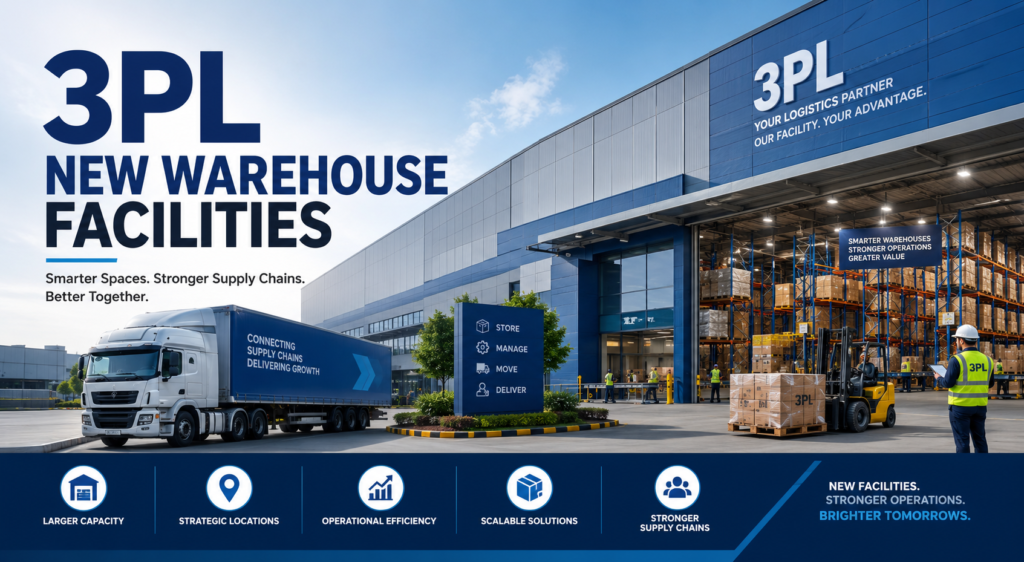
Traditional 3PL new warehouse facilities warehouses were primarily focused on storage. Products arrived, employees placed them on shelves or pallets, and inventory remained there until an order was received. Modern 3PL facilities operate very differently. They combine storage with receiving, inventory management, picking, packing, shipping, returns processing, and sometimes specialized services such as kitting and product customization.
A new 3PL warehouse in 2026 is increasingly designed around workflow efficiency. The layout may be planned according to product velocity, order patterns, and shipping requirements. Fast-moving products can be positioned closer to packing stations, while slower-moving inventory can be stored in less accessible areas. 3PL New Warehouse Expanding 2026
This approach helps reduce unnecessary movement inside the facility. Even small improvements in warehouse processes can become significant when employees are processing thousands of orders. The goal is not simply to have more space, but to use that space intelligently.
Technology Is Driving Warehouse Expansion
Technology is one of the most important elements of modern 3PL expansion. Warehouse management systems help logistics providers track inventory, manage orders, coordinate employees, and monitor warehouse activity. Better software can also connect a 3PL warehouse with a customer’s online store, enterprise system, marketplace account, or order management platform. 3PL New Warehouse Expanding 2026
Automation is another major area of development. Depending on the size and purpose of a facility, 3PL warehouses may use conveyor systems, automated storage solutions, barcode scanners, robotic equipment, sorting technology, and other tools designed to improve productivity. Not every warehouse needs the same level of automation, but technology is becoming increasingly important across the industry. 3PL New Warehouse Expanding 2026
Data also plays a central role. Warehouse operators can analyze order volumes, inventory movement, picking times, shipping patterns, and other operational information. These insights can help businesses identify bottlenecks and make better decisions about inventory placement, staffing, and warehouse capacity. 3PL New Warehouse Expanding 2026
E-Commerce Continues to Influence 3PL Growth
E-commerce remains one of the strongest drivers of demand for 3PL services. Online sellers often experience unpredictable sales patterns, seasonal spikes, and rapid product growth. Building a private warehouse operation can be difficult when a company is still trying to determine how much space it will need in the future.
A 3PL provider gives growing brands the opportunity to outsource much of this complexity. A business can send inventory to a logistics partner, while the 3PL handles storage and fulfillment. As order volume increases, the provider may be able to offer additional warehouse space or move inventory between facilities. 3PL New Warehouse Expanding 2026
This flexibility can be particularly valuable for smaller and mid-sized businesses. Instead of making a major real estate investment, they can focus their resources on product development, marketing, customer service, and sales while their logistics partner manages the physical fulfillment process.
Strategic Warehouse Locations Matter More Than Ever
Warehouse expansion is not simply about adding square footage. Location is a major part of the equation. A warehouse positioned near major highways, transportation hubs, ports, airports, or large population centers can provide logistical advantages. 3PL New Warehouse Expanding 2026
In 2026, 3PL companies are likely to continue evaluating warehouse locations based on customer demand and transportation requirements. A network with several strategically positioned facilities can help businesses place inventory closer to their customers rather than shipping every order from a single central location.
Regional distribution can also provide greater flexibility during periods of disruption. If one location experiences capacity issues, transportation delays, or an unexpected surge in demand, inventory positioned elsewhere may help businesses maintain service levels.
Flexible Warehousing Is Becoming a Competitive Advantage
Businesses do not always need the same amount of warehouse space throughout the year. Retailers may experience significant seasonal increases during holidays, while other businesses may see demand change because of promotions, product launches, or market trends.
This makes flexible warehousing particularly valuable. A 3PL provider with an expanding warehouse network can potentially accommodate changing requirements more effectively than a company locked into a fixed private facility. 3PL New Warehouse Expanding 2026
Scalability is one of the strongest reasons businesses choose third-party logistics. A growing brand can increase its inventory and order volume without immediately having to lease another building or build an entirely new fulfillment operation. This can make expansion less disruptive and easier to manage.
Warehouse Expansion and Inventory Management
More warehouse space does not automatically mean better inventory management. If inventory is poorly organized, additional square footage can simply create more room for inefficiency. Modern 3PL providers therefore need strong inventory control systems alongside physical expansion. 3PL New Warehouse Expanding 2026
Accurate inventory data is essential for businesses selling across multiple channels. A company may have products listed on its website, online marketplaces, wholesale accounts, and other sales channels. If inventory information is not updated accurately, overselling and stockouts can occur.
New 3PL warehouses are increasingly designed to support real-time or near-real-time inventory visibility. Better tracking can help businesses understand what they have, where it is located, and how quickly it is moving. This information supports smarter purchasing and replenishment decisions.
The Importance of Automation and Human Workers
It is easy to assume that warehouse expansion means replacing people with robots, but the reality is more balanced. Automation can handle repetitive and physically demanding tasks, while employees remain essential for decision-making, exception handling, quality control, customer requirements, and many specialized operations. 3PL New Warehouse Expanding 2026
The best-performing warehouses often combine technology with human expertise. Automation can help employees work faster and more accurately rather than simply eliminating their roles.
As 3PL facilities become larger and more sophisticated, employee training will remain important. Workers need to understand warehouse systems, scanning equipment, safety procedures, inventory processes, and customer-specific requirements. Technology is valuable, but it still depends on people who know how to use it effectively. 3PL New Warehouse Expanding 2026
What 3PL Expansion Means for Businesses
For businesses considering a 3PL partner in 2026, warehouse expansion can create new opportunities. More facilities can mean additional storage capacity, broader geographic coverage, and greater flexibility. However, businesses should not choose a provider based solely on warehouse size.
A large facility is only useful if the provider can manage inventory accurately and fulfill orders consistently. Businesses should examine factors such as warehouse management technology, integration capabilities, order accuracy, shipping options, customer support, scalability, and return processing.
It is also important to understand pricing. Different 3PL companies may charge separately for receiving, storage, picking, packing, shipping, returns, account management, and special projects. A detailed cost comparison can help businesses understand the actual value of a logistics partnership. 3PL New Warehouse Expanding 2026
Challenges Behind 3PL Warehouse Expansion
Although expansion offers many advantages, it also creates challenges. Constructing or leasing warehouse space requires significant investment, and operating costs can be substantial. Labor availability, transportation expenses, technology implementation, and facility management can all affect profitability.
There is also the challenge of matching capacity with demand. A 3PL provider that expands too aggressively may end up with unused space. On the other hand, insufficient capacity can lead to overcrowding, slower fulfillment, and dissatisfied customers. 3PL New Warehouse Expanding 2026
Technology integration can create another challenge. A new warehouse needs to communicate effectively with existing systems and customer platforms. Poor integration can lead to inaccurate inventory information, delayed orders, and unnecessary manual work.
How Businesses Can Prepare for 3PL Growth in 2026
Businesses planning to use a 3PL provider should start by understanding their current and expected logistics requirements. This includes average inventory levels, order volume, product dimensions, shipping destinations, seasonal demand, return rates, and future growth expectations. 3PL New Warehouse Expanding 2026
It is also useful to think beyond immediate storage needs. A business may currently require one warehouse but could need multiple fulfillment locations as it expands. Choosing a 3PL partner with a scalable network can make future growth easier.
Communication is equally important. A good logistics relationship should involve clear performance expectations and regular reporting. Businesses should understand how their provider measures order accuracy, inventory accuracy, fulfillment speed, shipping performance, and customer service. 3PL New Warehouse Expanding 2026
The Future of 3PL Warehousing
The expansion of 3PL warehouses in 2026 is part of a larger evolution in supply chain management. Warehouses are becoming more connected, automated, data-driven, and strategically important to the overall customer experience.
In the coming years, successful 3PL providers will likely focus on more than simply adding buildings. They will need to create intelligent networks that combine physical infrastructure, technology, skilled employees, transportation options, and accurate data.
For businesses, this evolution creates an opportunity to build stronger supply chains without owning every part of the operation. By partnering with the right 3PL provider, companies can gain access to professional infrastructure while maintaining the flexibility needed to grow.
Final Thoughts on 3PL New Warehouse Expanding 2026
The trend represented by “3PL new warehouse expanding 2026” is ultimately about more than warehouse construction. It reflects the changing expectations of modern commerce and the need for supply chains that can adapt quickly.
As businesses continue to compete on availability, delivery speed, convenience, and customer experience, logistics will remain a major part of their strategy. New 3PL warehouses can provide the space and infrastructure needed to support that growth, especially when combined with modern technology and effective inventory management.
For companies evaluating logistics options in 2026, the smartest approach is to look beyond warehouse size. The real value comes from a 3PL provider’s ability to combine capacity, technology, strategic locations, operational expertise, and scalability. When those elements work together, a modern 3PL warehouse becomes much more than a storage facility—it becomes an important part of a company’s growth strategy.
You May Read Also:

